How to Measure for an E Cup: Band, Bust and Fit Guide
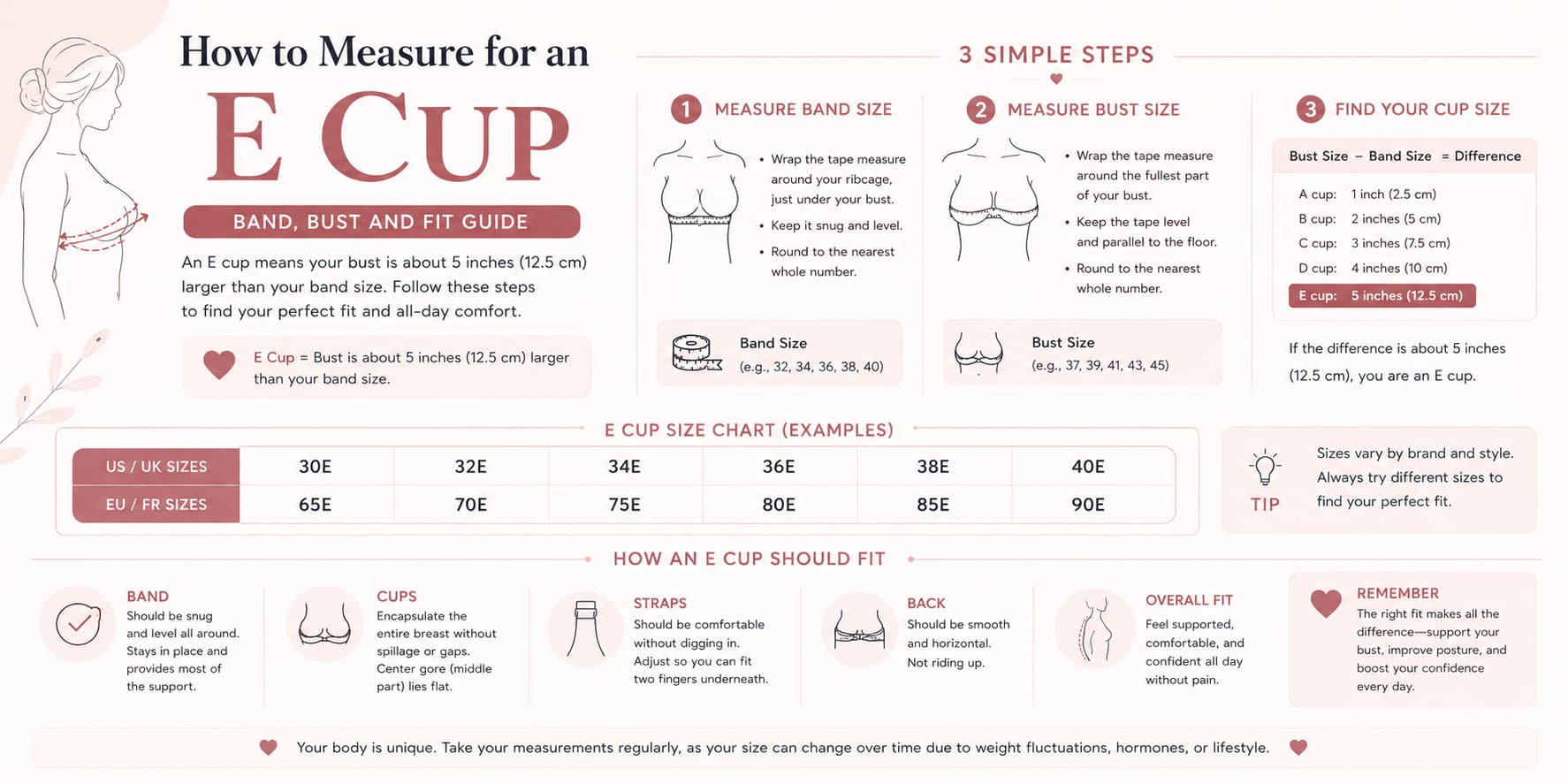
To measure for an E cup, measure your underbust for band size, then measure the fullest part of your bust. The cup letter comes from the difference between bust and band. Because E cup sizing varies by country and brand, compare your result with the brand’s own size chart.
How do you measure for an E cup?
You measure for an E cup by measuring your underbust, measuring your fullest bust, calculating the difference and comparing the result with a size chart.
For SG/MY users, it also helps to compare inch-based sizes such as 30E, 32E, 34E, 36E, 38E and 40E with cm-based sizes such as 65E, 70E, 75E, 80E, 85E and 90E.
- Prepare a soft measuring tape. Use a flexible tape and stand in a relaxed, upright position. Wear a lightly supportive, non-padded bra if that feels more comfortable.
- Measure underbust. Wrap the tape snugly around your ribcage, just under the bust. Keep the tape level and note the number.
- Measure fullest bust. Wrap the tape around the fullest part of your bust. Keep it level without pressing into the tissue.
- Calculate the difference. Subtract your band measurement from your bust measurement. This difference helps estimate the cup letter.
- Compare with a size chart. Check whether your difference sits near E cup in the chart you are using.
- Check real-life fit signs. A measured size is only a starting point; the bra should still feel smooth, stable and comfortable when worn.
What measurements usually make an E cup?
An E cup usually means your bust measurement has a larger difference from your band measurement, but the exact number can vary by country and brand chart.
Many size charts place E after DD and before F, but not all charts name cup steps the same way. This is why “E cup measurement” should be treated as a guide, not a universal rule.
| Cup Letter | Common Cup Difference Guide | How to Read It | Fit Reminder |
|---|---|---|---|
| B | Smaller bust-to-band difference | Usually below C and D in the same chart | Check the brand’s exact measurement table. |
| C | Moderate bust-to-band difference | Usually above B and below D | Band size still changes cup volume. |
| D | Larger bust-to-band difference | Often comes before DD | Country naming can vary after D. |
| DD | Often one step before E | Commonly used between D and E | Some charts may name this area differently. |
| E | Usually one step above DD in many charts | The focus size in this guide | Read it with the band size, such as 34E or 75E. |
| F | Usually one step above E in many charts | Often more cup depth than E on the same band | Confirm against the brand’s own chart. |
How to calculate cup size
You calculate cup size by subtracting your band measurement from your bust measurement, then matching the difference to a cup chart.
The key is to use one size system at a time. If you measure in inches, compare with an inch-based chart. If you measure in centimetres, compare with a cm-based brand chart. Mixing systems can make the result confusing.
- Underbust measurement helps estimate the band size.
- Fullest bust measurement helps estimate the cup size.
- Bust minus band gives the cup difference.
- Brand chart comparison confirms how that difference is labelled.
How to convert E cup into cm-based sizes
You convert E cup into cm-based sizes by matching the band number to common Asian or EU-style band labels, then keeping the E cup letter.
In many SG/MY charts, 30E may appear as 65E, 32E as 70E, 34E as 75E, 36E as 80E, 38E as 85E and 40E as 90E. These are common comparisons, but brand sizing can vary.
| Inch-Based Size | Common CM-Based Size | Simple Meaning |
|---|---|---|
| 30E | 65E | E cup on a smaller 30 / 65 band |
| 32E | 70E | E cup on a 32 / 70 band |
| 34E | 75E | E cup on a 34 / 75 band |
| 36E | 80E | E cup on a 36 / 80 band |
| 38E | 85E | E cup on a 38 / 85 band |
| 40E | 90E | E cup on a 40 / 90 band |
How should an E cup bra fit?
An E cup bra should feel secure at the band, smooth through the cups and comfortable at the straps and front area.
Measurement gives you a starting size, but real-life fit decides whether the bra works for your body, outfit and daily comfort. Use this checklist after trying on an e cup bra size.
- Band sits level around the body.
- Cups do not gape.
- Cups do not overflow.
- Straps do not carry all the support.
- Center/front area feels comfortable.
- Cup edge sits smoothly under clothing.
Choose comfort only after checking your size range
After measuring, always check the product’s size range before choosing. A seamless bra, wireless bra or minimizer bra may feel helpful for different daily outfits, but the best option is the one that covers your exact band and cup size.
Gentle E cup bra styles to compare after measuring
These styles are light starting points after measurement, not a shortcut around fit. Check each product’s own size guide before choosing your band and cup.

VEIMIA Elegant Wireless Deep V Bra With Support For B-E Cups
Best for: Relaxed daily comfort with wireless support.
$49.00 SGD Wireless B-E cups Daily comfort Check wireless fit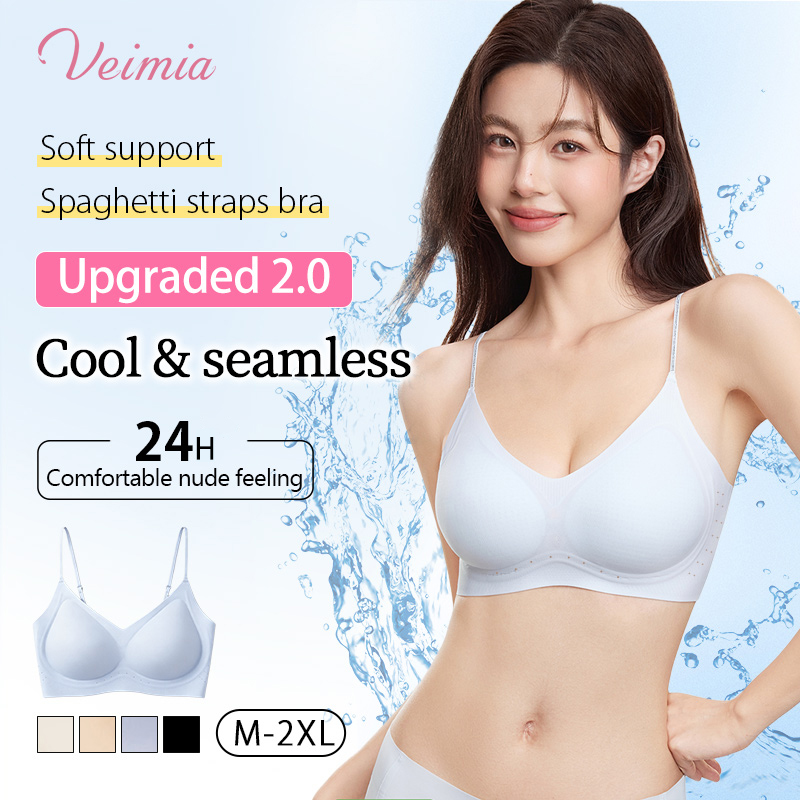
UPGRADED 2.0 VEIMIA Cooling Seamless Bra
Best for: Cooling, breathable comfort under light daily outfits.
$39.00 SGD Cooling Seamless Soft support Check seamless fit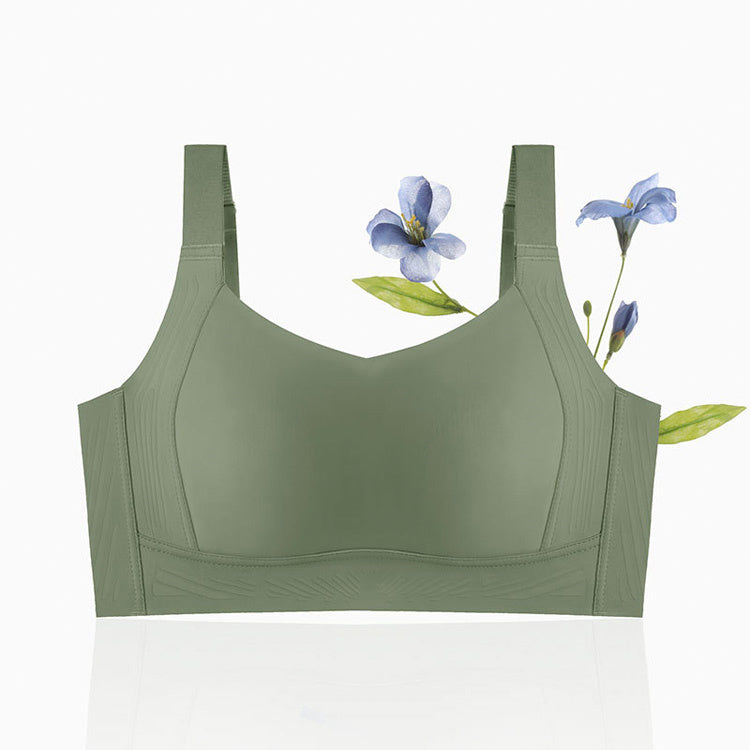
VEIMIA Seamless Back Smoothing Minimizer Bra With Stable Full Coverage
Best for: Fuller coverage and smoother daily outfit lines.
$39.00 SGD Full coverage Back smoothing Stable fit Check minimizer fitWhat to do if you are between DD, E and F cup
If you are between DD, E and F cup, compare fit signs on the same band size before changing the band.
If DD feels shallow, E may be worth checking. If E still overflows, F may be worth checking on the same band. If the cup feels close but the band feels wrong, sister sizing may be more useful than changing only the cup letter.
- If the cup overflows, try a deeper cup or a fuller-coverage style.
- If the cup gaps, check whether the cup is too deep or the style shape is not matching you.
- If the band rides up, the band may be too loose.
- If the band feels harsh, check the band size, hook position and fabric stretch.
- If sizing differs by brand, follow the product’s own chart first.
FAQ About Measuring for an E Cup
Q1: How do I know if I am an E cup?
A: You may be an E cup if your bust-to-band difference matches E cup on the size chart you are using. Always confirm with real-life fit signs and the brand’s own size guide.
Q2: What is E cup measurement in cm?
A: E cup measurement in cm depends on the brand’s chart and your band size. In many SG/MY charts, E cup may appear as 65E, 70E, 75E, 80E, 85E or 90E.
Q3: Is E cup always the same in every country?
A: No, E cup is not always the same in every country. Cup naming around DD, E and F can vary by size system, country and brand.
Q4: What if I am between DD and E cup?
A: If you are between DD and E cup, try both on the same band size and compare fit signs. Choose the cup that feels smooth without gaping or overflow.
Q5: What if my E cup bra gaps or overflows?
A: If your E cup bra gaps, the cup may be too deep or the style may not match your shape. If it overflows, the cup may be too shallow or the coverage may be too low.